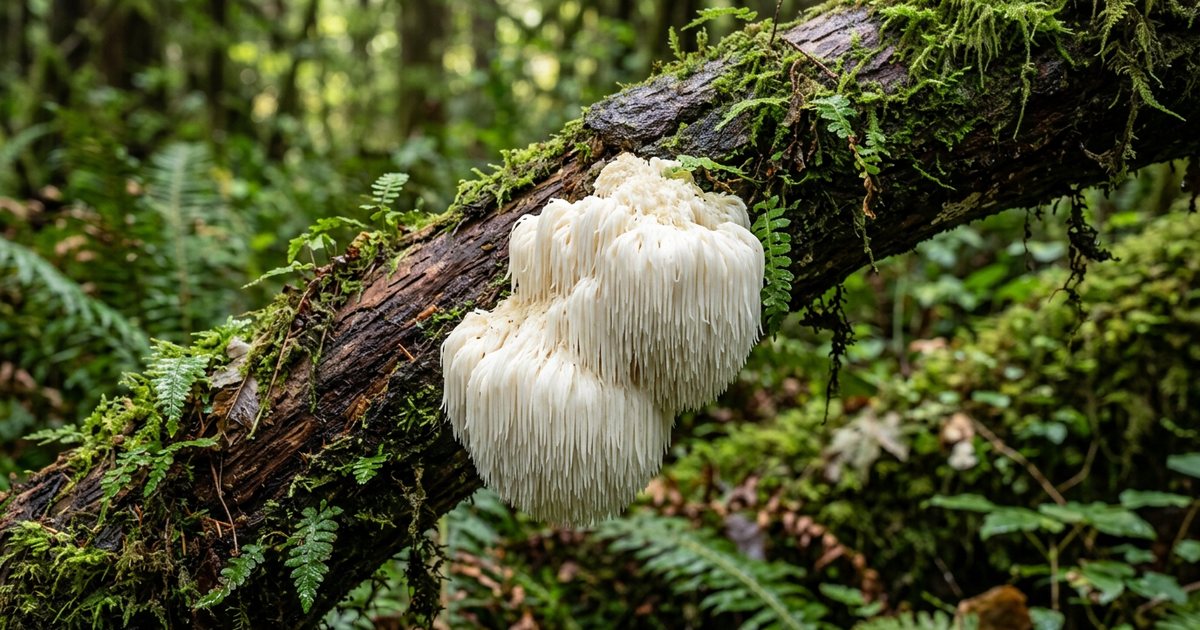
Most lion’s mane content on this site, and most of the marketing around it, treats gut health as a side note to a cognitive story: the gut-brain axis, the vagus nerve, general digestive comfort. There is a more specific and less-discussed body of research that is not about digestion broadly, it is about lion’s mane and a particular gut pathogen, Helicobacter pylori, and the gastric ulcers it causes. That research is worth its own look.
This site participates in the Amazon Associates program and may earn a commission on qualifying purchases. Nothing here has been evaluated by the FDA, and nothing in this article is a substitute for treating a diagnosed H. pylori infection with prescribed antibiotics.
Key Takeaways
- Multiple in vitro studies have found lion’s mane extracts directly inhibit H. pylori growth, with effect sizes that vary by extraction method and solvent [1] [2].
- A polysaccharide fraction from lion’s mane mycelium significantly reduced ulcer area in an ethanol-induced gastric ulcer animal model, in a dose-dependent way [3].
- This research is exclusively in vitro (lab dish) and animal models; there is no published human clinical trial testing lion’s mane against active H. pylori infection or gastric ulcers.
- Traditional Chinese medicine has used H. erinaceus for gastric complaints for centuries, which is part of why researchers investigated it in the first place, but traditional use is not clinical proof.
- Lion’s mane should never replace the standard antibiotic triple or quadruple therapy used to eradicate confirmed H. pylori infection.
Why Researchers Looked at H. Pylori Specifically
Hericium erinaceus has a documented history in traditional Chinese medicine for treating symptoms associated with gastric ulcers and general stomach complaints. That traditional use gave researchers a starting point, and over roughly the past two decades a cluster of laboratory studies has tested whether there is a measurable biological basis for it, specifically against Helicobacter pylori, the bacterium responsible for the majority of peptic ulcers and a recognized risk factor for gastric cancer.
What the In Vitro Studies Found
A 2019 study testing ethanolic extracts of lion’s mane against multiple H. pylori strains found the extract inhibited growth at a minimum inhibitory concentration of roughly 2 mg/mL. The same study found the extract reduced H. pylori-triggered IL-8 production, a marker of the inflammatory immune response the bacterium provokes, and blunted an oxidative DNA damage marker (8-oxoG) that rises during infection [1]. A separate study isolating specific bioactive fractions from the mushroom, crude ethanol extracts as well as petroleum ether and chloroform fractions, found meaningful anti-H. pylori activity, with the non-polar fractions showing the strongest inhibition [2]. A separate comparison of 14 medicinal mushroom species specifically highlighted lion’s mane’s ethyl acetate fraction as active against nine clinical H. pylori isolates, with minimum inhibitory concentrations in the 62.5 to 250 microgram-per-mL range.
What the Ulcer-Protection Studies Found
Separate from the direct antibacterial angle, researchers have tested whether lion’s mane protects the stomach lining itself. A polysaccharide fraction isolated from lion’s mane mycelium significantly reduced ulcerated area in a mouse model of ethanol-induced gastric injury, with the protective effect scaling with dose [3]. A related rat study found the extract prevented depletion of the stomach’s own antioxidant enzymes during ulcer formation and shifted expression of proteins involved in cell survival (upregulating HSP70, downregulating BAX), suggesting a gastroprotective mechanism distinct from directly killing bacteria.
The Gap Between This Research and a Human Recommendation
Every study cited here used cell cultures, isolated bacterial strains, or rodent models. None of it involved a person with a confirmed H. pylori infection taking an oral lion’s mane supplement and being retested for eradication. The minimum inhibitory concentrations found in lab dishes also do not translate directly to what a standard capsule or powder dose would achieve in stomach tissue after digestion. This is genuinely promising foundational research, not a validated treatment.
What This Means If You Have Confirmed H. Pylori or Ulcers
Standard antibiotic eradication therapy remains the only evidence-based treatment for confirmed H. pylori infection, and stopping or skipping it in favor of a supplement risks antibiotic resistance and untreated infection, which carries real long-term risk including gastric cancer. Where lion’s mane might reasonably fit is as a general gut-supportive addition once a person is already under medical care for the infection, discussed with the treating doctor rather than substituted for the prescribed protocol.
Frequently Asked Questions
Can lion’s mane cure H. pylori on its own?
No human trial has tested this, and it should not be used as a substitute for prescribed antibiotic eradication therapy for a confirmed infection.
Is lion’s mane safe to take alongside H. pylori antibiotic treatment?
There is no known dangerous interaction, but timing and appropriateness should be confirmed with the prescribing physician, particularly since some antibiotic protocols already include a bismuth or proton-pump component that affects the stomach environment.
Does lion’s mane help general digestion, not just ulcers?
Separate research on lion’s mane and gut microbiota diversity exists and is covered elsewhere on this site; this article is specifically about the H. pylori and ulcer-protection research.
What form of lion’s mane was used in these studies?
The studies cited here used ethanolic extracts and isolated polysaccharide fractions from mycelium, not whole dried mushroom powder, which may behave differently.
How do I know if I have H. pylori?
Diagnosis requires a breath test, stool antigen test, or endoscopic biopsy ordered by a doctor. Symptoms like burning stomach pain, bloating, and nausea are not enough to self-diagnose.

References
- Wang G, Zhang X, Maier SE, et al. In Vitro and In Vivo Inhibition of Helicobacter pylori by Ethanolic Extracts of Hericium erinaceus. Int J Med Mushrooms (2019). PMID 30806251
- Liu J, Li L, Shang X, et al. Anti-Helicobacter pylori activity of bioactive components isolated from Hericium erinaceus. J Ethnopharmacol (2016). PMID 26364939
- Wang M, Konishi T, Gao Y, et al. Anti-Gastric Ulcer Activity of Polysaccharide Fraction Isolated from Mycelium Culture of Hericium erinaceus. Int J Med Mushrooms (2015). PMID 26853960
These statements have not been evaluated by the FDA. This product is not intended to diagnose, treat, cure, or prevent any disease. This article is for informational purposes only and is not a substitute for professional medical advice. As an Amazon Associate we earn from qualifying purchases.
These statements have not been evaluated by the Food and Drug Administration. This information is not intended to diagnose, treat, cure, or prevent any disease. Content is for informational purposes only and is not medical advice; consult a qualified healthcare provider before starting any supplement. As an Amazon Associate we earn from qualifying purchases.